Introduction
C# has made massive strides in adopting functional programming paradigms over the years. However, there’s one relic that still consistently interrupts clean, fluent data pipelines: the out parameter.
If you’ve ever tried to parse a string inside a LINQ query or a chain of method calls, you know the frustration. You have to break your flow, declare an uninitialized variable, and write an if statement just to handle an int.TryParse. It is functional friction.
Fortunately, there is a cleaner way. Let’s look at how we can leverage the Esox.SharpAndRusty library to achieve elegant, “out-free” parsing.
The Clunkiness of Traditional Parsing
We’ve all written this boilerplate countless times:
string input = "42";
if (int.TryParse(input, out int age))
{
    // Handle the success case
    ProcessAge(age);
}
else
{
    // Handle the failure case
    LogError("Invalid age input");
}
While safe, this pattern forces you to mutate state (via the out parameter) and rely on branching logic. It completely breaks down if you want to chain operations or use C#’s LINQ syntax.
Enter Rust-Inspired Parsing
Esox.SharpAndRusty is a production-ready C# library designed to bring Rust-inspired patterns to the .NET ecosystem. Built for .NET 10 and C# 14, it introduces type-safe error handling explicitly through a Result<T, E> type.
One of the most practical quality-of-life improvements the library offers is Out-Free Parsing. By wrapping C#’s native parsing logic in extension methods, the library completely eliminates the need for out parameters.
How Out-Free Parsing Works
Instead of returning a boolean and mutating a variable, the library’s TryParse extension methods return a Result<T, Error>.
Here is what out-free parsing looks like in practice:
using Esox.SharpAndRusty.Extensions;

// Simple string parsing to a Result type
Result<int, Error> parsedAge = "42".TryParse<int>();

// Delegate-based helpers for specific or custom parsers
Result<int, Error> customParsed = "10".TryParse<int>(int.TryParse, nameof(int.TryParse));
By returning a Result, the parsing operation explicitly captures both the success state and the potential failure state in a single, composable object.
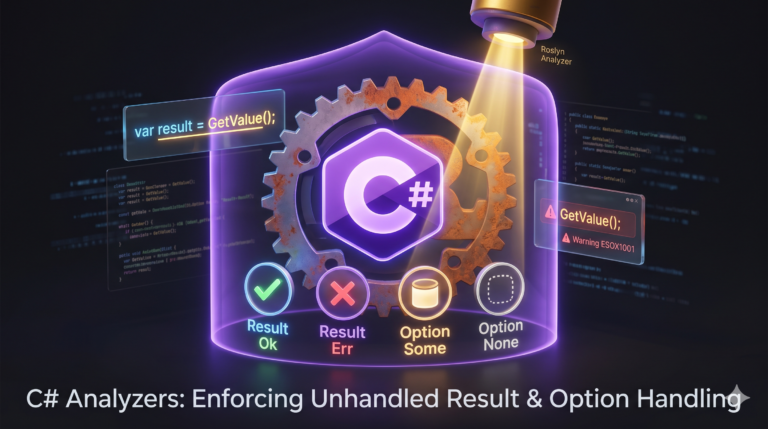
When combined with the Esox.SharpAndRusty.Analyzers package, you can make sure that the results are handled property.
Why This is a Game Changer
Transitioning to out-free parsing unlocks a much more fluent and expressive way to write C#. Here are the immediate benefits:
1. Safe Value Extraction
You no longer have to check boolean flags. You can interact safely with the parsed value using the library’s extraction methods. If you simply want an optional value without dealing with the error, you can instantly convert the result into a Rust-inspired Option<T>:
Result<int, Error> parsedAge = "42".TryParse<int>();

// Safely extract to an Option<T> (No out parameters!)
Option<int> ageOption = parsedAge.ValueOption();

// Or extract the error if you need it
Option<Error> parseErrorOption = parsedAge.ErrorOption();
2. Functional Composition
Because the parsed value is wrapped in a Result, you can chain subsequent operations seamlessly using Map or Bind. If the initial parse fails, the subsequent functions simply are not executed, and the error propagates down the chain automatically.
var resultMessage = "100".TryParse<int>()
    .Bind(value => Divide(value, 5)) // Bind chains operations that can also fail
    .Map(value => $"The calculated result is {value}"); // Map transforms the success value
3. Rich Error Handling
When a standard TryParse fails, you just get a false. You don’t know why it failed. Esox.SharpAndRusty utilizes a rich Error type that automatically categorizes failures. For example, when you use the library’s error wrappers, exceptions like FormatException are automatically mapped to ErrorKind.ParseError.
4. LINQ Compatibility
Because the library fully supports C# LINQ query comprehension (via SelectMany and Select), you can use standard query syntax to parse multiple values cleanly:
var combinedResult = from x in "10".TryParse<int>()
                     from y in "20".TryParse<int>()
                     select x + y;
Conclusion
If you want to keep your codebases clean, explicit, and functional, dropping out parameters is a massive step forward. By adopting Result-based parsing through Esox.SharpAndRusty, you can write safer code that flows naturally, without sacrificing the performance of native C# parsing techniques.
If you like this, why not contribute, or just letting me know in which projects you are using it? Also if you find any bugs, or have ideas for features, I am also very interested to hear from you.
To check out the library, see the Esox.SharpAndRusty GitHub Repository.